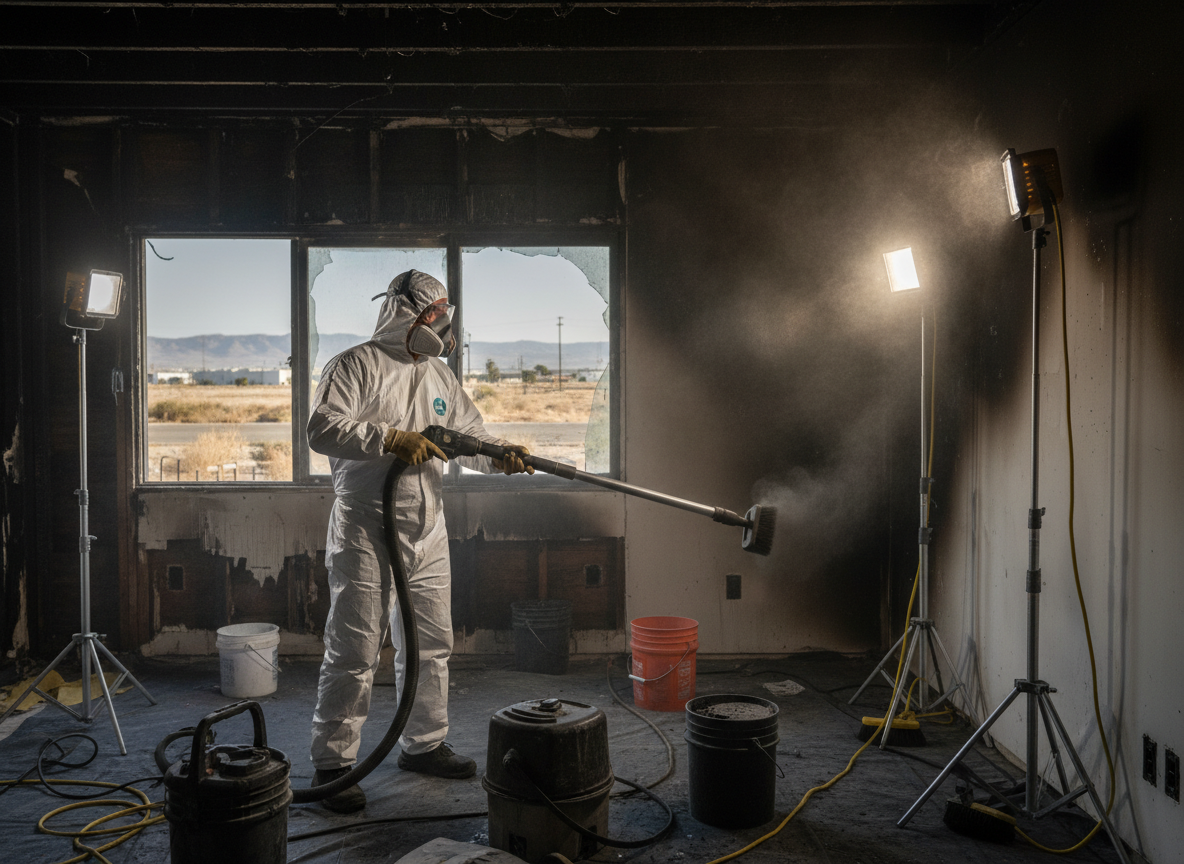
Soot from structure fires in Guasti often travels through forced-air ducts and settles on popcorn ceilings common in 1970s tract homes near the 10 freeway. These fine particles bond to latex paint and textured surfaces, requiring pH-neutral cleaners and HEPA vacuuming rather than simple wiping that can drive residue deeper. Technicians must also address the alkaline ash left on concrete slabs typical of local single-story builds, because moisture from suppression water turns the mix into a caustic film that etches tile grout.
Edge cases appear when fires start in detached garages common along Turner Avenue; wind patterns push oily soot under eaves and into attic insulation. Standard drywall sanding then risks releasing embedded carbon into living spaces. Containment with negative-air machines and three-stage air scrubbing is required before any surface work begins. Older aluminum window frames found in many Guasti homes trap soot in the tracks, demanding disassembly rather than in-place cleaning to prevent later corrosion.
Local building practices mean many homes lack vapor barriers behind exterior stucco, so smoke odor can migrate from wall cavities during temperature swings. Sealing with shellac-based primers after cleaning prevents recurring smells. Technicians always test for hidden moisture in subfloors before final clearance, because Guasti’s clay-heavy soil holds water longer after suppression efforts.
Technician insight
In Guasti, the thing that catches most people out with Soot removal is how the alkaline ash from house fires bonds to the unsealed stucco on homes built along Turner Avenue and nearby streets; once it gets wet from cleanup water it etches the finish and homeowners think a pressure wash will fix it, but that just drives the residue into the paper facing of the drywall behind the weep screed.
Soot in 1970s Ranch Home Near Turner Ave
Smoke from a kitchen fire traveled through the attic and coated popcorn ceilings and return-air ducts. Inspection showed alkaline residue on exterior stucco that had wicked into wall cavities. Crews contained the home, cleaned surfaces with neutral agents, disassembled and vacuumed the ductwork, then sealed with appropriate primers. Odor was eliminated and the family returned within four days.
How it works
- 1
Initial Assessment
Inspect all affected rooms, HVAC runs and attic spaces to map soot migration patterns specific to Guasti construction.
- 2
Containment Setup
Isolate work zones with plastic barriers and negative air to keep particles from spreading into unaffected areas.
- 3
Surface Cleaning
Apply appropriate cleaners to walls, ceilings and hard surfaces while protecting porous materials like carpet and insulation.
- 4
Air Scrubbing and Clearance
Run HEPA filtration until particulate levels meet post-fire standards, then conduct final walkthrough.
Pricing
Cost depends on square footage affected, number of surfaces and whether HVAC cleaning is required; upfront quotes provided after inspection.