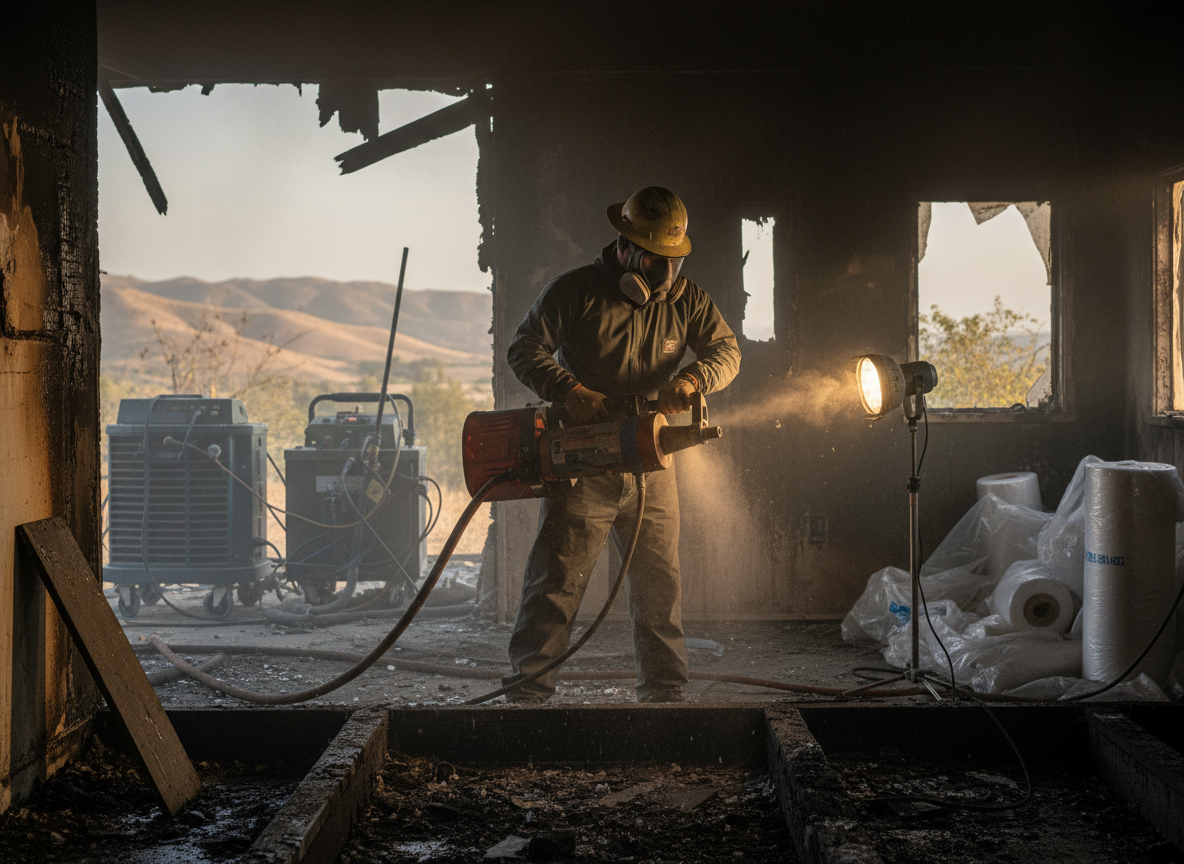
Emergency fire damage restoration in Guasti begins with securing the structure and preventing further collapse in older San Bernardino County homes that often feature wood framing and plaster walls from the mid-20th century. Crews assess hidden charring behind siding and in attic spaces where embers travel through shared rooflines common in neighborhoods near the 10 freeway corridor. Immediate air quality testing follows to map smoke penetration into HVAC systems that can spread contaminants into living areas of nearby Ontario and Rancho Cucamonga properties.
Soot removal requires different techniques depending on whether the fire involved synthetic materials or natural fuels, and Guasti's dry inland climate leaves residue that bonds quickly to porous surfaces like concrete slabs and drywall. Technicians use specialized equipment to extract odors from insulation without disturbing load-bearing elements in single-story ranch homes typical of the area. Coordination with local permitting ensures any temporary shoring meets county requirements before reconstruction starts.
Water used during suppression creates secondary mold risks in Guasti's low-lying spots near Turner Avenue where drainage is slow. Restoration includes targeted drying of subfloors and wall cavities to avoid long-term issues in properties built before modern vapor barriers became standard. Final clearance testing confirms the space meets habitability standards before owners return.
Technician insight
In Guasti the thing that catches most people out with emergency fire damage restoration is how quickly smoke travels through the shared attic spaces of 1960s tract homes along Turner and nearby streets. Once it hits the insulation the odor stays unless you pull and replace it rather than just fogging. Dry Santa Ana wind periods also make residue bond harder to stucco and concrete, so the first 48 hours matter more here than in coastal spots.
Smoke Through Shared Attic
A kitchen fire in a Guasti ranch house sent smoke into the attic that crossed into two neighboring units. We found heavy soot on rafters and in fiberglass batts that standard cleaning would miss. After removing the insulation, treating the wood, and drying the cavities we restored all three homes to clearance without odor return.
How it works
- 1
Secure And Assess
Board up openings and evaluate structural integrity plus smoke paths through the home.
- 2
Remove Debris And Soot
Extract charred materials and clean surfaces using methods matched to residue type.
- 3
Dry And Deodorize
Address water from firefighting and neutralize odors trapped in cavities and ducts.
- 4
Rebuild And Clear
Restore affected areas and verify air quality before final walkthrough.
Pricing
Costs depend on fire size, affected square footage, and materials involved; we provide upfront written estimates after inspection.