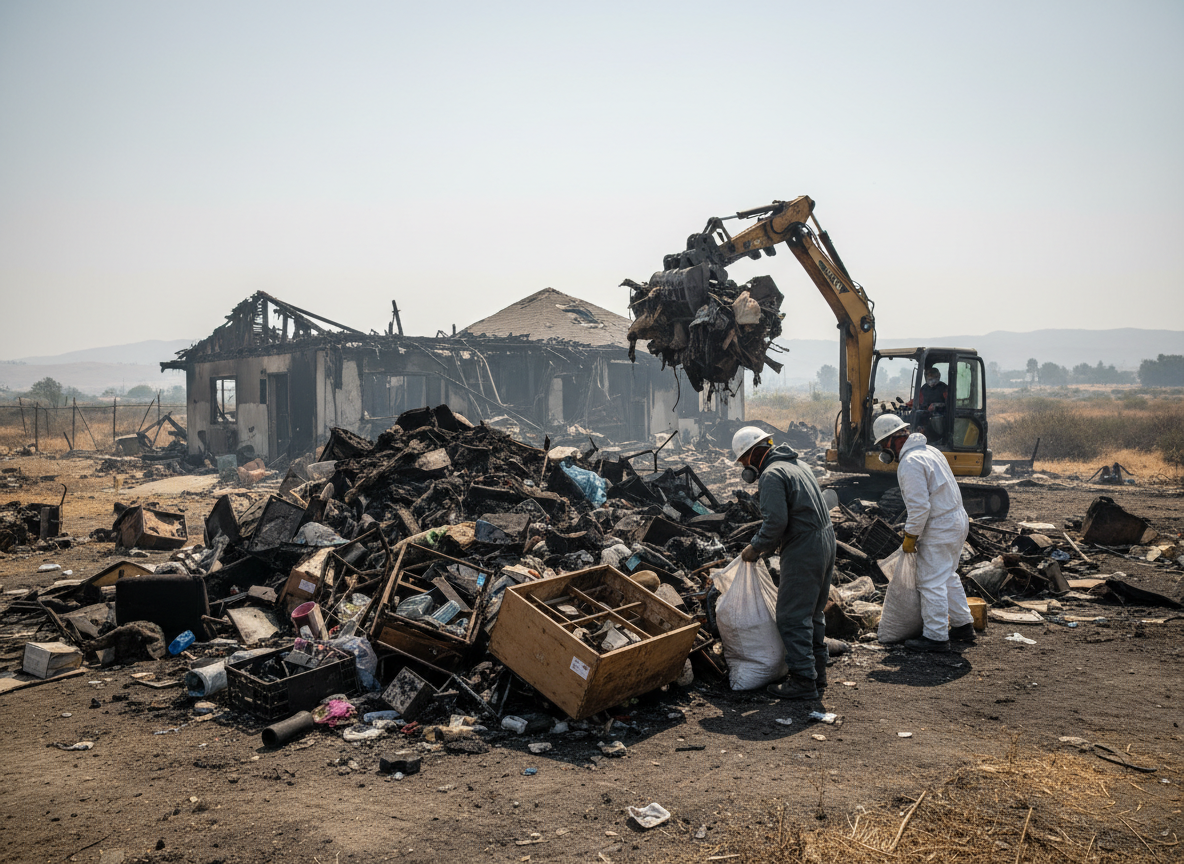
Hoarding situations after a fire create layered hazards because accumulated paper, fabrics, and plastics fuse with soot and char. In Guasti homes near the industrial corridors off Turner Avenue, older single-story structures with limited attic ventilation allow smoke to settle into dense piles for days. Technicians must separate salvageable items from contaminated waste while wearing full PPE to avoid inhaling particulates mixed with household chemicals. Failure to isolate these zones risks cross-contamination into unaffected rooms during removal.
Dry conditions common in the Guasti area accelerate ember penetration into compacted materials, turning ordinary clutter into deeper fuel pockets. Crews begin by establishing negative air pressure to contain airborne particles before any sorting occurs. Edge cases include hidden moisture from suppression efforts that can trigger mold growth inside stacked boxes within 48 hours. Local code requires proper manifesting of certain debris streams when they leave the site, especially if batteries or aerosols are present in the hoard.
Work stops only after HEPA vacuuming of all surfaces and verification that odors no longer register on monitoring equipment. Homeowners often overlook the need to treat subflooring and behind baseboards where fine ash migrates. In Guasti properties, this step prevents lingering smells that otherwise return when temperatures rise. Documentation of every load hauled away satisfies both insurance adjusters and county health requirements.
Technician insight
In Guasti, the thing that catches most people out with hoarding cleanup after fire is how the dry winds along Turner Avenue drive fine ash deep into stacked paper and fabric before crews arrive, forcing extra time spent behind baseboards and under subfloors that homeowners never expect.
Hoarded Bungalow Off Turner Avenue
Smoke from a kitchen fire had saturated boxes stacked to the ceiling in a single-story home. We found smoldering embers still active inside compacted clothing piles near the rear wall. Negative air was established immediately, followed by careful layer-by-layer removal and HEPA cleaning of all surfaces. The property passed clearance testing within four days and was returned to the owner without lingering odors.
How it works
- 1
Site Assessment And Containment
Technicians evaluate the extent of fire and hoard overlap, set up containment barriers, and establish negative air flow before any material is disturbed.
- 2
Selective Removal And Sorting
Items are categorized on-site into salvage, contaminated waste, and hazardous streams while crews document volumes for insurance purposes.
- 3
Deep Cleaning And Deodorization
Remaining surfaces receive HEPA vacuuming, antimicrobial treatment, and odor neutralization to address embedded smoke residue.
- 4
Final Clearance And Haul Away
Air quality is verified, all waste is manifested, and the property receives a final walkthrough before turnover.
Pricing
Pricing varies by volume of debris, contamination depth, and access constraints; upfront quotes follow on-site evaluation.