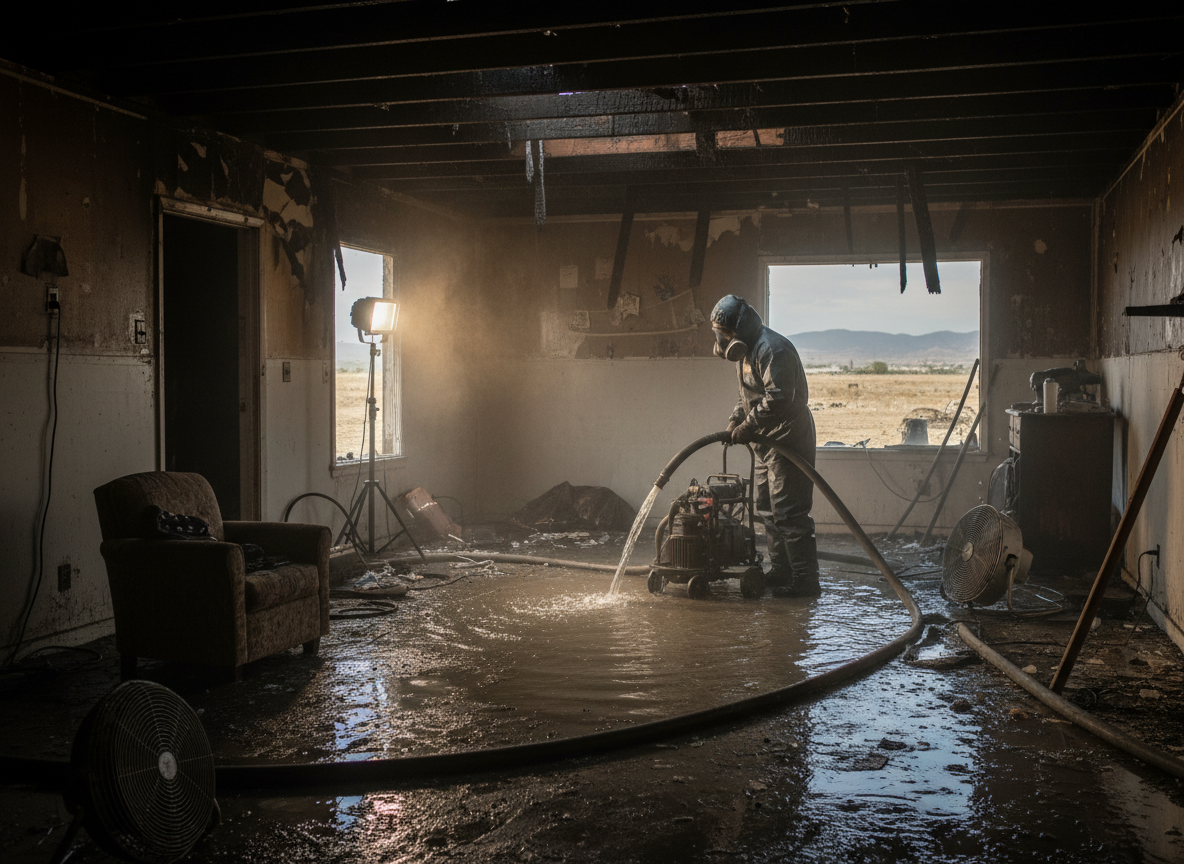
In Guasti, older residential and light industrial buildings along Turner Avenue and nearby streets often feature plaster walls and crawl spaces that trap both soot and standing water after a fire followed by rain. Technicians begin by isolating power and gas, then remove saturated insulation and charred debris before any drying equipment is placed. Failing to separate these steps allows acidic ash to remain in contact with copper wiring and metal studs, accelerating corrosion that shows up months later as electrical faults or musty odors.
Seasonal Santa Ana winds push embers into attics while winter rains can back up drainage along the Union Pacific tracks that border the neighborhood. When both occur, gypsum board behind cabinets and under flooring must be cut out in sections rather than simply dried, because the combination of heat and moisture creates hidden mold colonies within 48 hours. Local crews carry negative-air machines sized for the smaller lot sizes typical here to avoid pulling contaminated air into adjacent units.
San Bernardino County code requires permits for any structural repairs exceeding ten percent of the wall area, so documentation of every removed section is kept from the first visit. Homeowners in Guasti frequently discover that insurance adjusters undervalue the cost of cleaning HVAC ducts that run through shared walls with neighboring properties, leaving residual smoke odor that only appears when the system cycles on again.
Technician insight
In Guasti, the thing that catches most people out with Fire and flood restoration is how quickly ash from nearby rail traffic mixes with floodwater in crawl spaces of pre-1970 homes, creating an acidic slurry that eats through floor joists before drying even starts.
Crawl-space ash and rainwater intrusion
A kitchen fire on Turner Avenue sent smoke into the attic; two days later heavy rain pooled against the foundation. We found ash-laden water had wicked up into the subfloor. After removing saturated insulation and treating the joists, the home passed clearance testing within five days.
How it works
- 1
Emergency Site Securement
Board up openings, shut off utilities, and set up containment to prevent further water or smoke migration into unaffected rooms.
- 2
Combined Debris and Water Removal
Extract standing water while removing charred materials and ash-laden insulation in the same pass to limit cross-contamination.
- 3
Drying and Monitoring
Place air movers and dehumidifiers, then log moisture readings daily until levels match unaffected areas of the structure.
- 4
Sanitization and Odor Control
Apply EPA-registered antimicrobials to affected surfaces and run hydroxyl or ozone equipment to neutralize smoke residue.
- 5
Final Clearance and Documentation
Conduct visual and moisture inspection, photograph repairs, and supply paperwork needed for insurance and county permits.
Pricing
Upfront written estimates provided after on-site inspection; final cost depends on square footage affected and whether structural repairs are required.