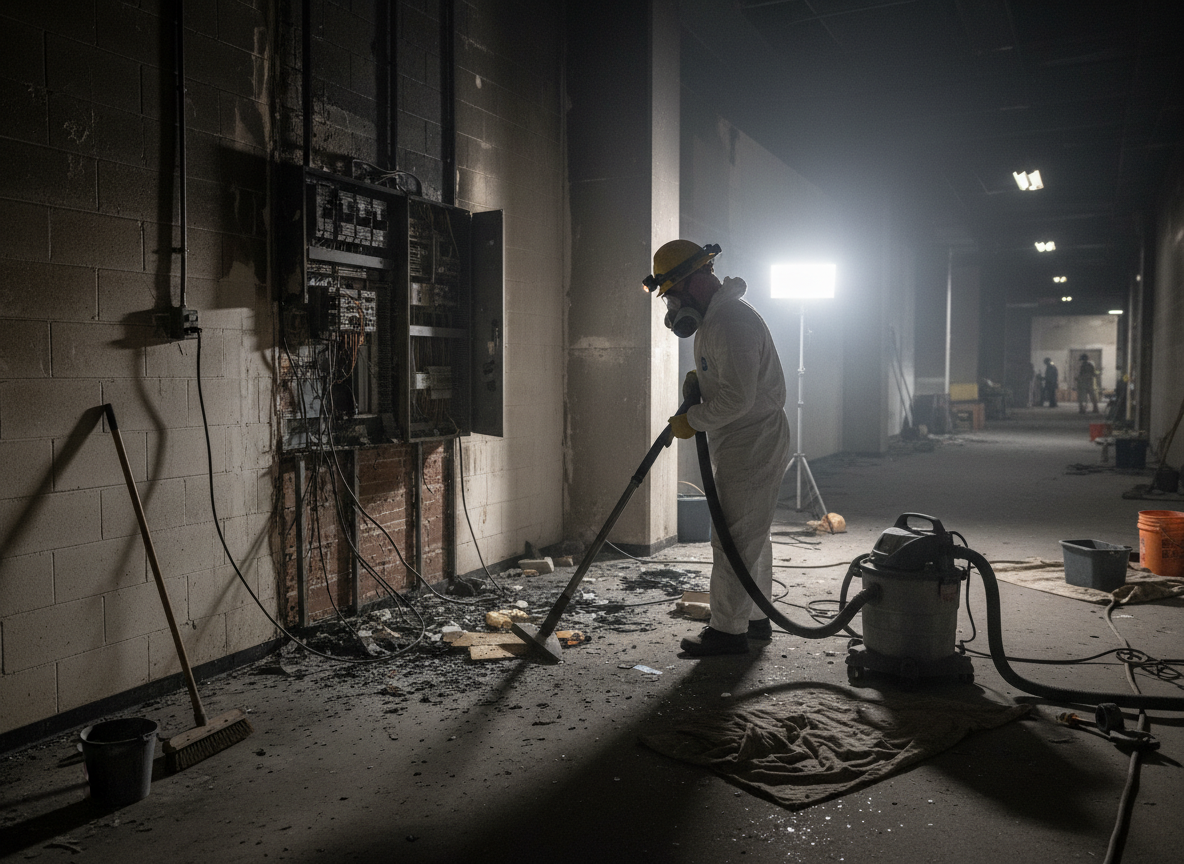
Electrical fires in Guasti often start in older single-family homes near the rail yards and industrial pockets along Turner Avenue, where aluminum wiring from the 1960s and 1970s remains common. These runs overheat at connections, leaving fine carbon soot that travels through shared attic spaces and into HVAC ducts serving multiple rooms. Cleanup requires isolating circuits before any vacuuming begins, because residual current can energize hidden conductors coated in conductive soot. Technicians test each outlet and junction box with a multimeter after initial removal to locate arcing points that standard visual checks miss.
Dry Santa Ana conditions accelerate soot adhesion to drywall and insulation in Guasti, turning what looks like surface staining into embedded contamination within hours. Once the fire is out, crews remove affected sections of Romex or knob-and-tube runs rather than attempting surface cleaning, because code in San Bernardino County requires replacement when insulation shows heat damage. Homeowners frequently overlook the service panel; even when the fire started downstream, breakers can carbon-track internally and fail to trip on future overloads. Full documentation of every replaced conductor satisfies insurance adjusters who visit properties along the I-10 corridor.
Ventilation patterns in Guasti tract homes push smoke downward through wall cavities toward slab foundations, depositing residue on copper pipes and under cabinets. Technicians use HEPA air scrubbers staged at exterior doors to prevent cross-contamination into unaffected wings, a step that becomes critical when properties sit close together on narrow lots. Post-cleanup verification includes infrared scans of ceilings to confirm no retained heat in recessed lighting cans, which can reignite if left unaddressed.
Technician insight
In Guasti, the thing that catches most people out with Electrical fire cleanup is how quickly soot migrates into the shared attic spaces of 1960s tract homes along Turner and nearby streets when the dry winds pick up; homeowners think wiping visible surfaces is enough, but the real job is tracing every run back to the panel before the next Santa Ana event pushes residue deeper.
Electrical Fire Cleanup on Turner Avenue
An outlet in a Guasti home built in the late 1960s overheated and ignited insulation in the wall cavity. Inspection showed carbon tracking through the attic shared with the neighboring unit and soot inside the main panel. Crews isolated the affected circuits, removed contaminated wiring and drywall, cleaned the HVAC trunk, and replaced the breaker before restoring power.
How it works
- 1
Scene Safety and Power Isolation
Confirm utilities are secured, then map all circuits before any material handling begins.
- 2
Soot and Debris Removal
HEPA vacuum and wipe all surfaces, removing contaminated insulation and drywall sections as needed.
- 3
Wiring and Panel Inspection
Test every conductor and breaker with meters and thermal imaging to locate hidden arc damage.
- 4
Restoration and Verification
Replace damaged wiring, reinstall finishes, and run final air-quality and circuit-load checks.
Pricing
Upfront quotes provided after on-site inspection of affected circuits and soot spread.